




A New Horizon for the Mendoza Plum: The Impact of the European Union-Mercosur Agreement
(Source: Based on information published by San Rafael Daily)
The entry into force of the trade agreement between the European Union and Mercosur marks a turning point for the regional economies of Mendoza. For the plum sector, the gradual elimination of tariffs promises to end a historical disadvantage compared to direct competitors, but it also demands an unavoidable leap towards efficiency and modernization within the farms themselves.
The End of Historical Asymmetry
For years, Argentine plums had to sacrifice profit margins to remain competitive. According to Lucio Álvarez, President of the Mendoza Plum Industry Exporters Committee (CECIM), the reality was clear: «With our main competitor, Chile, the European Union has zero tariffs. Therefore, Argentina always had to price its plums 101% below the Chilean price to level the playing field.».
This new scenario transforms that dynamic. The tariff reduction will be phased in over five years:
– May 2026: Immediate reduction to 7.8%.
– 2027: Projected decrease to 5%.
– Year 5: Definitive zero tariff.
The benefit of this tariff reduction will directly impact local production and marketing, since the price on the European shelf will remain stable for the consumer, allowing the Argentine producer and exporter to recover the profitability lost due to customs duties.
The Productivity Crossroads: The 12,000 Kilos Challenge
However, trade liberalization doesn't come without a price. Competing on equal terms with European and global production requires a drastic increase in productivity.
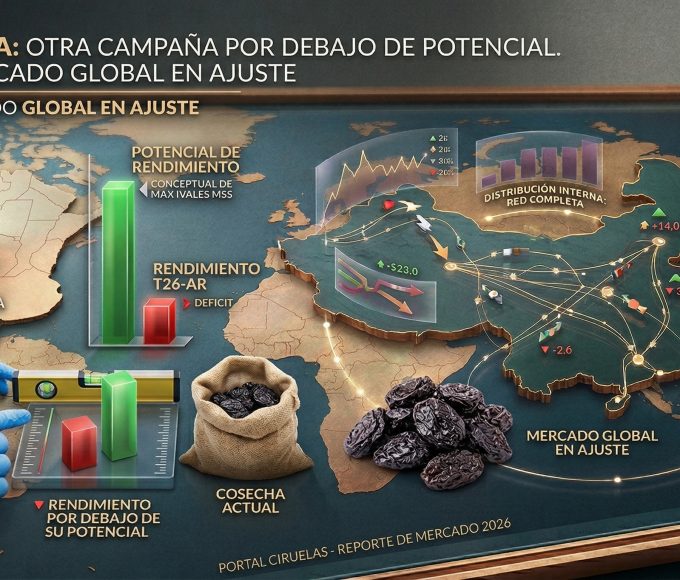
The viability of the business is now defined, in no uncertain terms, by the yield per hectare:
– The profit floor: For farming to be profitable today, it is necessary to harvest between 10,000 and 15,000 kilos per hectare, approximately.
– The current reality: «"The average provincial and national production barely reaches 6,000 kilos per hectare«.
– The possible objective: There are technologically advanced local producers who already far exceed the 25,000 kilos per hectare.
«"It is preferable to have one good hectare that produces 20,000 kilos, rather than 50 hectares that yield only 5,000 kilos each," emphasizes Álvarez, calling for a cultural shift in the management of Mendoza farms.
The New Role of the State: Opening Markets vs. Welfare
Faced with the profitability crisis affecting many links in the supply chain, CECIM proposes a paradigm shift in state agricultural policy. Instead of prioritizing financial assistance for producers with outdated production models, the State should focus its resources on diplomacy and trade liberalization.
Unlocking key markets (such as the agreement to enable exports to China, a country with extremely high demand) has a multiplier effect. When exports flow and the international price is passed on to the producer, the most genuine incentive arises for farmers to reinvest their own capital, clear old forests, prune, fertilize, and increase their yields.
Is Your Plantation Ready to Compete?
The European Union-Mercosur agreement is now a reality that requires adaptation. Global demand is currently assured for quality food, but the market demands both volume and traceability.
Discover how to optimize your yields and prepare your farm for international standards by exploring our technical resources at Portal Ciruelas.


 Spanish
  English
  Chinese


Leave a comment