




UNITED STATES · MARKETS
FULL SUPPORT FOR THE CALIFORNIA PRUNE BOARD: Mandate extended to 2030 and guaranteed trade defense
The industry verdict: why processors defend the Marketing Order
The mandatory consultation by the California Department of Food and Agriculture (CDFA) concluded with a resounding verdict: the California plum industry decided to maintain its institutional structure for another five-year term. Formally established in 1980 to coordinate growers and handlers in the Sacramento and San Joaquin valleys, the California Prune Board (CPB) passed the technical and legal review with testimonials highlighting its critical role in the economic survival of the orchards.
Far from being a mere administrative formality, this guarantee represents a direct financial commitment from the operators themselves. In an environment marked by inflation in agricultural inputs, the cost of water on the West Coast, and pressure from new, low-cost sources in Central and Middle Asia, producers opted to continue taxing their deliveries to finance a common fund for trade defense, genetic innovation, and international promotion.
The ratification comes at a time of strategic retreat for the North American origin. As we analyzed in [California's Shield: Stable Harvest of 68,000 Tons and a Balanced Supply to Sustain Firm Prices](https://portalciruelas.com/2026/07/21/el-blindaje-de-california-cosecha-estable-de-68-000-toneladas-y-una-oferta-equilibrada-para-sostener-precios-firmes/), California is no longer pursuing record production in gross tonnage, but rather consolidating a profitability floor supported by large sizes and standardized industrial drying. The extension of the mandate guarantees that this trade policy will not suffer cracks or individual defections during the next five years.
|
1980
Formal creation of the California Prune Board under the tutelage of the CDFA.
|
2000
Strategic shift: nutritional repositioning and name change.
|
2015
Opening of advanced research programs in bone and intestinal health.
|
2020
Industrial adaptation: total mechanization of harvesting and selective thinning.
|
2026
Favorable vote from handlers and growers to extend the mandate.
|
2030
New expiry date set by the CDFA for the current operating scheme.
|
The engine of the price premium: science, calibers, and high-income markets
The economic reason behind the support of the US packers lies in the price premium (premium price) that California plums maintain a presence on the most demanding supermarket shelves worldwide. International industry reports agree that Californian plums command a price premium of up to 401% compared to competing origins in markets such as Japan, the United Kingdom, Canada, and Italy.
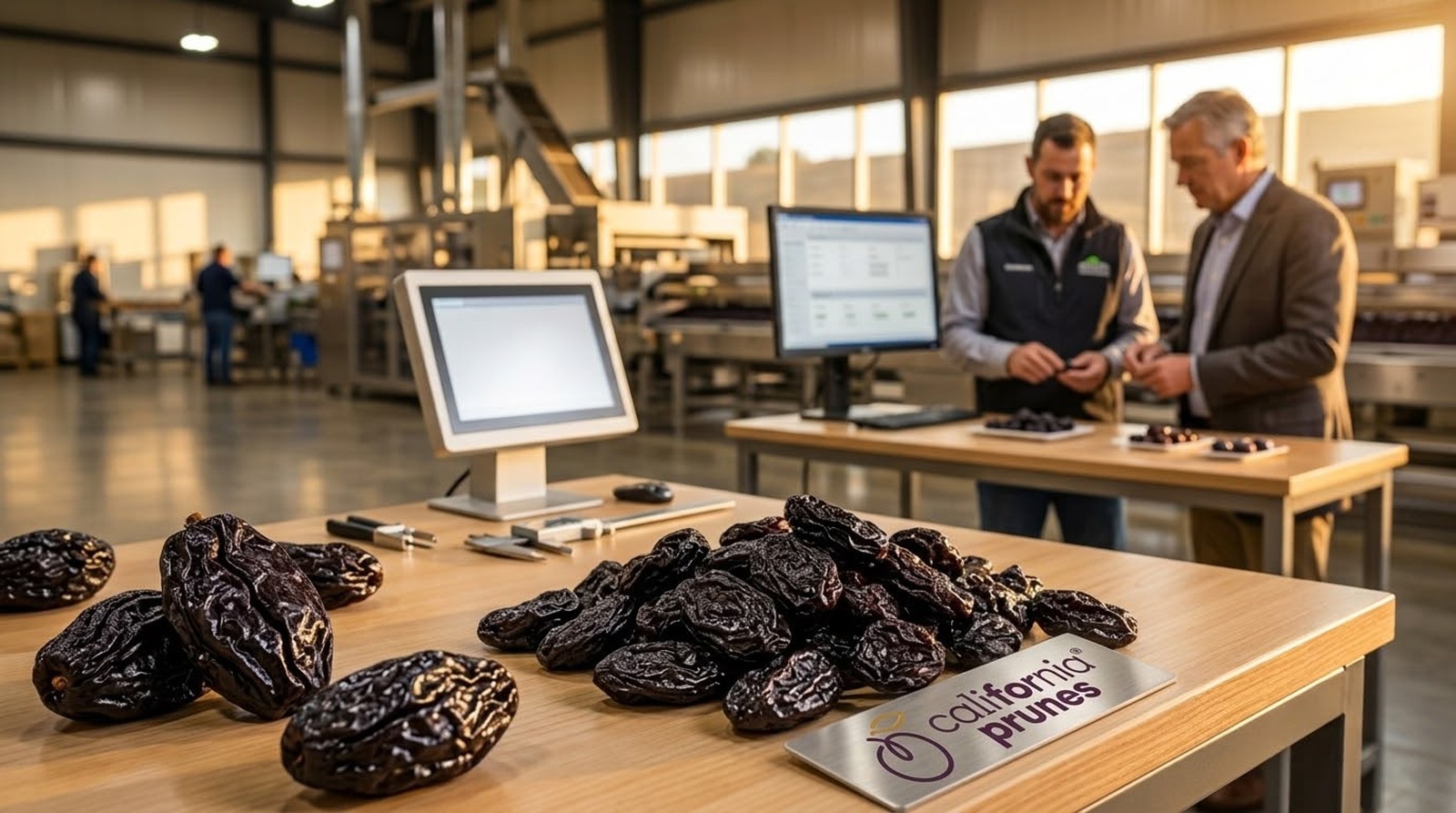
This difference does not arise from agronomic chance, but from a sustained investment in two pillars that no isolated producer can afford on their own: 1. Scientific evidence transferable to marketing: The CPB funds clinical trials on bone health, microbiota, and metabolic performance, providing importers with arguments supported by indexed publications. 2. Industrial homogeneity and calibers: Technical field control—which includes rigorous mechanical thinning (shaker thinning) and scheduled harvesting— ensures that the fruit delivered to the drying ovens belongs to the most sought-after size ranges, moving away from the small segments that saturate the commodity market.
By concentrating its budget in markets where the end consumer prioritizes the perception of safety and organoleptic uniformity, the collective scheme manages to insulate its members from the abrupt fluctuations in international prices that hit standard stone fruit.
While California has secured institutional funding through 2030 for research and healthcare development, competing countries in the Southern Hemisphere and Central Asia operate with more fragmented promotional schemes or rely on temporary state subsidies. The lack of industry coordination in other countries threatens to relegate them to the role of low-cost suppliers just as China expands its holdings in Xinjiang.
The lessons California offers for global competition
The CDFA's decision also offers essential insights for other exporting countries. As Joe Turkovich argued in [Value Leadership: The Next Phase of the Global Industry from a California Perspective](https://portalciruelas.com/2026/04/15/liderazgo-en-valor-la-proxima-fase-de-la-industria-global-segun-la-perspectiva-de-california/), future competition in the plum industry is shifting from gross tonnage to product sophistication. The rise of competitors operating with significantly lower labor costs makes the survival of any exporter relying solely on undifferentiated volume unfeasible.
The Californian case demonstrates that an efficient Marketing Order does not act as a price-fixing cartel, but rather as a shared quality shield. The CPB establishes strict export quality and phytosanitary protection protocols that prevent defective fruit from entering international channels, thus protecting the reputation of the designation of origin.
For processing industries in South America and Europe, the message is direct: without institutional crowdfunding structures that promote quality, the returns gap with US-based products will continue to widen. Process certification, the move towards precision pitting (pitted) and the development of retail packaging demand a critical mass of resources that the atomization of producers cannot provide.
- **Analyze the contribution structure:** Evaluate how voluntary retention schemes or marketing orders can be replicated in local trade associations to finance trade missions and the opening of markets such as India.
- **Monitor R&D programs:** Closely follow CPB-validated nutritional protocols; these discoveries open up functional labeling opportunities for the entire category globally.
- **Segment by value channels:** Identify buyers in Europe and Asia who demand tenderized, large-sized fruit with full traceability, where competition does not depend exclusively on FOB price.
The renewal of the California Prune Board's mandate until 2030 confirms that the world's leading producer of premium prunes will maintain its strategy unchanged: controlled orchards, active research, and an unwavering focus on the premium segment. In a global market increasingly strained by emerging suppliers, consolidating a strong reputation for origin is no longer a secondary option, but rather the only viable insurance policy.


 Spanish
  English
  Chinese


Leave a comment