




CHINA · MARKETS AND PRODUCTION
CHINA HARVESTS 410,000 TONS IN 2026: Record production and collapse of prices at origin.
Jiashi's production ceiling: unprecedented volume and margin compression
The Jiashi plum-growing region in Kashgar Prefecture (Xinjiang) reaffirmed its status as the undisputed epicenter of European plum production in Asia this season. With a stable planted area of 38,000 hectares (570,000 mu)—half of the national total—the district boasted 30,000 hectares in full production this year (450,000 mu). The result was a record harvest of 410,000 tons, representing 701% of the country's total supply. Looking at recent trends, the leap is impressive: in 2022, the total planted area was around 25,000 hectares (380,000 mu); in just four seasons, it has grown by 501%, pushing China's national total to over 66,700 hectares (1,000,000 mu), according to industry estimates.
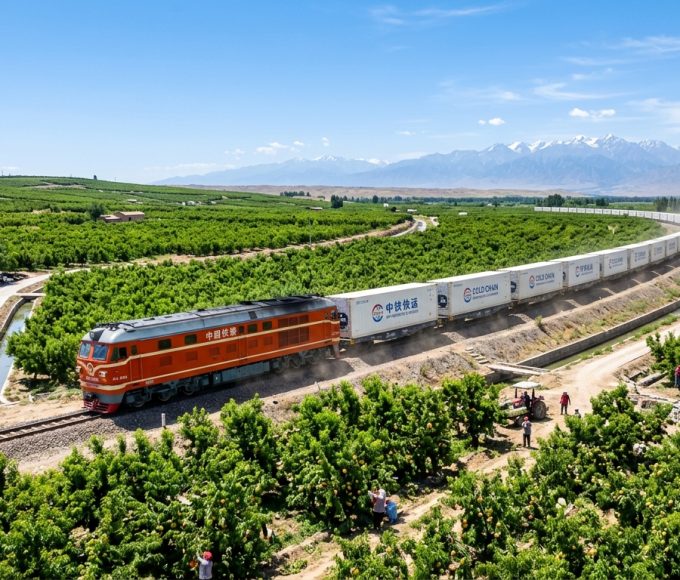
This rollout had strong institutional backing. The designation «Jiashi Xinmei» (伽师新梅) consolidated its protected geographical indication with an estimated brand valuation of 3.806 billion yuan (about 540 million dollars). Furthermore, in April 2026, the fruit was formally included in the official catalog of medicinal herbs of Xinjiang, enabling new functional and pharmaceutical developments. However, as we analyzed in [The Jiashi Express: How Chinese State Logistics and 38,000 Hectares of Plum Orchards Are Reshaping the Asian Market](https://portalciruelas.com/2026/08/20/el-expreso-de-jiashi-como-la-logistica-estatal-china-y-38-000-hectareas-de-ciruela-estan-reconfigurando-el-mercado-asiatico/), logistical speed and scale are not enough if commercial demand does not keep pace with the fruit orchard.
|
2024 (Pico Premium)
25 – 30 RMB/kg
Selected fruit amidst a surge in domestic demand
|
2022 (Standard)
13 – 17 RMB/kg
Historical balance range for early harvest fruit
|
2026 (Current closing date)
7 RMB/kg
Record low at the producer level due to seasonal oversupply
|
The 2026 paradox: superlative quality on a saturated channel
While production plummeted, prices followed suit. By August 2026, the farmgate price for standard fruit had fallen to 7 yuan per kilogram, marking a loss of between 451 and over 701 yuan per kilogram, depending on the segment, representing an unprecedented collapse in farmgate prices. In Beijing's retail markets, fresh fruit was selling for a mere 7.98 yuan per 500 grams at the end of August. In key wholesale markets like Chongqing (Shuangfu), large-sized boxes (25g+) were trading at 45 yuan per 1.5 kg (15 RMB/kg), while in Sichuan, wholesale sales of high-end lots were reported at 1.5 yuan per half kilogram.
The decline was not due to agronomic deficiencies; quite the contrary. An exceptionally dry winter and spring favored optimal health, superior firmness, an intact bloom, and an ideal pulp transition. By the beginning of September, the marked temperature range in Xinjiang had raised the sugar concentration to extraordinary levels of between 23 and 26 degrees Brix, compared to the 20-22 recorded at the beginning of August.
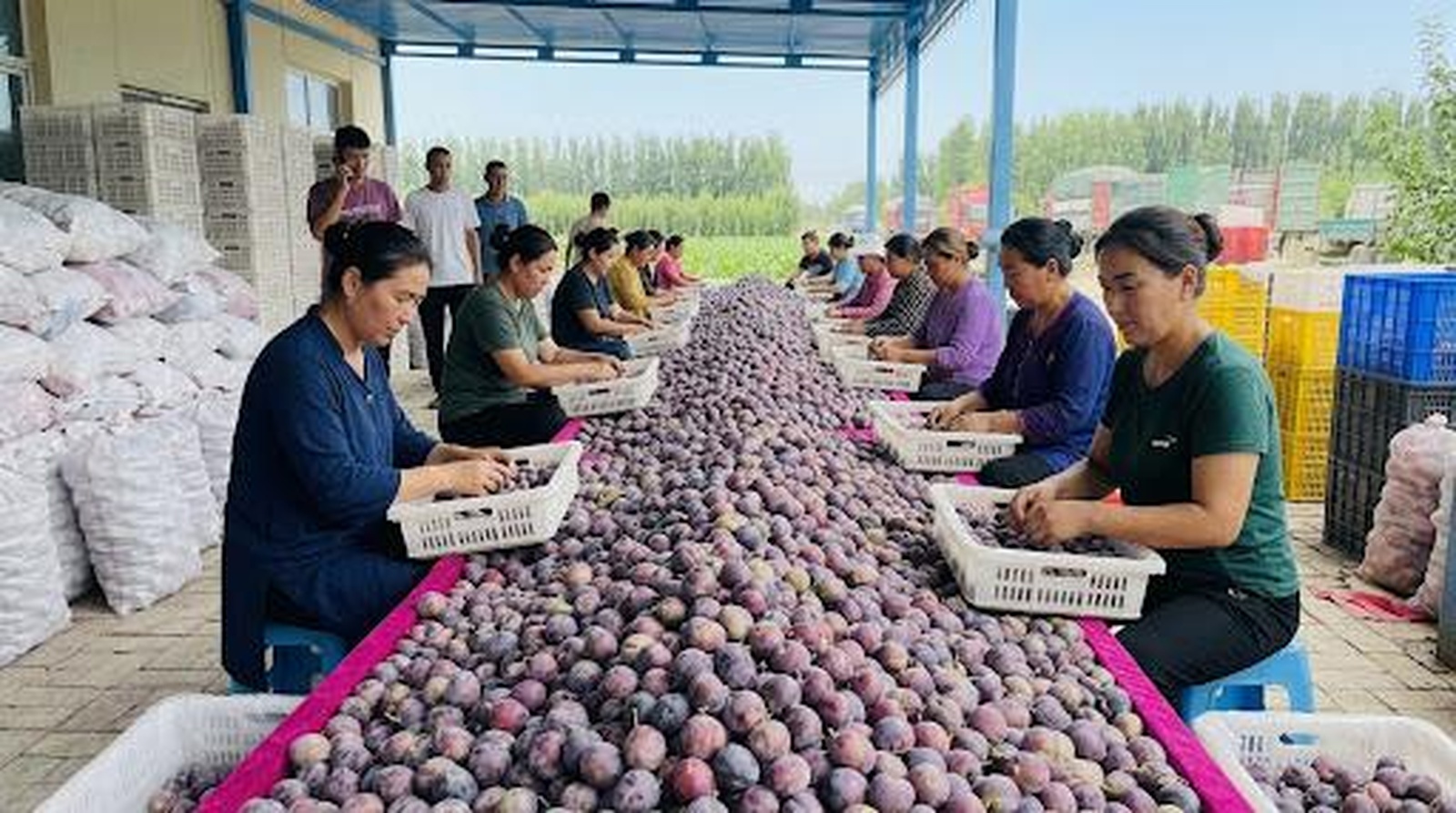
The bottleneck is strictly commercial and structural: the fresh plum harvesting window in Xinjiang lasts only 45 to 60 days. Placing more than 400,000 tons in less than two months on a domestic market dominated by cautious consumption resulted in an inevitable bottleneck in the distribution channel.
The concentration of a massive harvest within a 60-day window overwhelmed China's cold chain and wholesale distribution systems. With no immediate capacity to absorb the fresh produce, the farm gate price fell below the operating costs for many family farms.
Drying's lifeline: import substitution and the export frontier
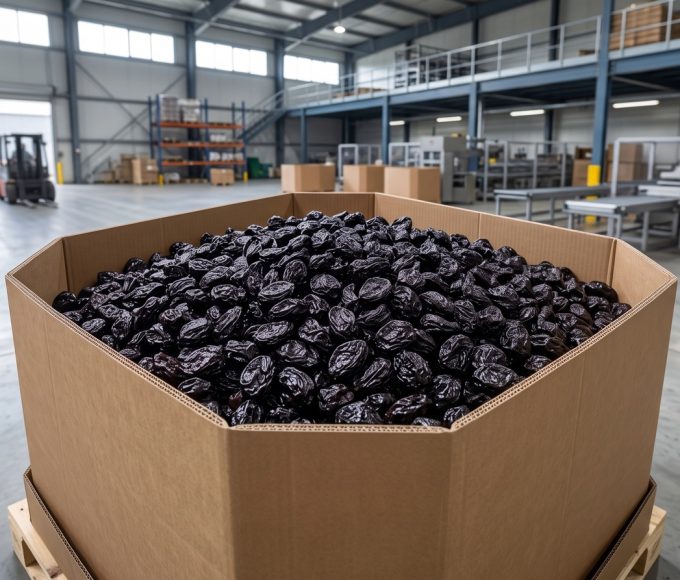
Faced with weak fresh fruit consumption, the local industry accelerated its shift towards industrial processing. The production matrix, historically divided between 701,000 tons for fresh fruit and 301,000 tons for processing, is rapidly moving towards dehydration. In Jiashi, plants like the Nongle cooperative operate 43 drying facilities that process between 150 and 180 tons of fresh fruit daily to obtain 30 to 35 tons of dried fruit. Companies like Jiangxiang Fruit process 500 tons of fresh fruit per shift with a conversion ratio of 3.8 to 1, achieving a yield that currently provides net margins 201,000 tons higher than fresh sales.
This surge transformed domestic supply. At the beginning of the decade, China relied on imported dried plums, primarily from the United States and Chile, for 901,000 tons. By 2026, this dependence had decreased to between 301,000 and 401,000 tons, entirely replaced by domestic drying in continuous ovens. Simultaneously, derivative products such as juices and snacks are growing at a compound annual growth rate of 121,000 tons.
The current limitation lies in the external front. While traditional suppliers operate with mature commercial networks, Chinese plums have virtually no participation in international trade beyond occasional shipments to Southeast Asia. They still lack widespread global certifications (GlobalGAP, HACCP) and packaging standards to compete on equal footing in Europe or the Middle East.
- For traditional exporters to China: The window for generic dried plums and medium sizes is definitely narrowing in the face of Xinjiang's advance; the profitable business is concentrated on extra-large sizes and tenderized pitted plums.
- For the global dehydrated fruit industry: The conversion ratio of 3.8:1 and the drying margins at Jiashi confirm that the Chinese surplus will seek an outlet in international markets for pulps, juices, and bulk dried fruit as soon as quality standards are certified.
- For planners and producers: The case of Xinjiang demonstrates that expanding hectares without prior industrial diversification collapses the producer's return, regardless of the Brix degrees obtained in the harvest.
The New Plum Industry Conference, held on August 8, 2026 in Jiashi, left an unequivocal message: the Asian giant is moving decisively towards deep processing and functional foods to prevent the 2027 harvest from repeating this price imbalance.






 Spanish
 English
 Chinese


Leave a comment