






China: The World's Largest Market for Fresh D'Agen Plums
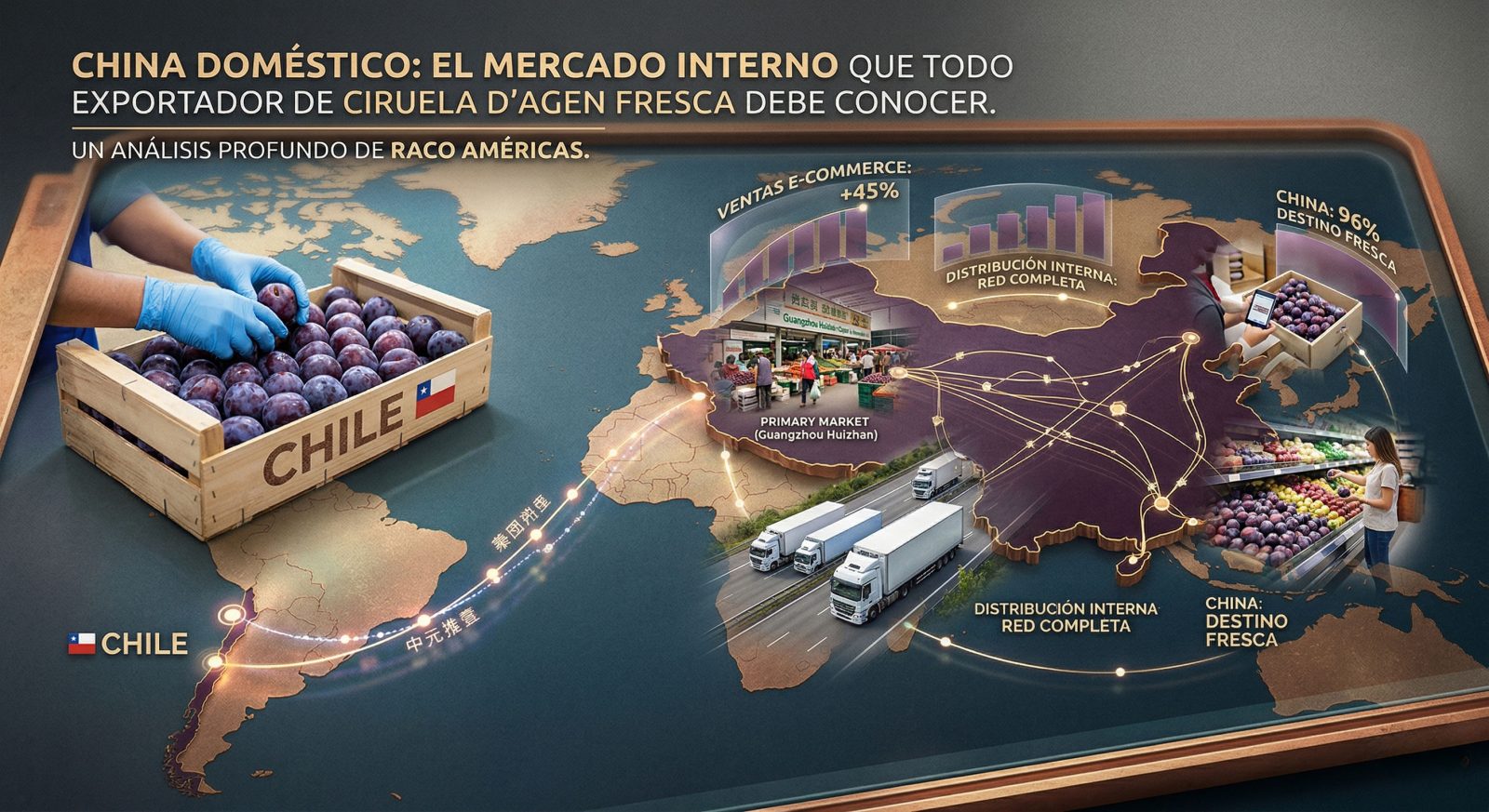
China is not only the main destination for Chilean exports of fresh D'Agen plums; it is also the world's largest consumer market for this variety. Understanding the dynamics of the Chinese domestic market is crucial for any exporter seeking to compete there, as local production has very specific characteristics that limit the window of opportunity for imported products.
Chinese Domestic Production: Xinjiang as an Epicenter Zone
China has a significant domestic production base for fresh D'Agen plums, concentrated mainly in the region of Xinjiang, in the northwest of the country. According to data from Ranco's office in China (source: www.xjsx.gov.cn), the country currently has 60,000 hectares planted with this variety, which generates local production for fresh consumption of 464,000 tons. This figure places China as a global-scale producer of fresh D'Agen plums, although with a very different seasonality than that of the southern hemisphere.
Seasonality: The Window of Opportunity for Chile
Chinese domestic production is mainly traded between July and August, This period, when the country's wholesale markets are supplied with fresh, locally grown plums, precisely defines the window of opportunity for exporters from the southern hemisphere, especially Chile, whose harvest occurs between November and February (southern summer months), allowing access to the Chinese market just when local production has ended and demand has not yet been met by new local harvests.
Format and Price: Market Parameters
In the Chinese market, the The main sales format is the 2-kilogram box, This applies to both local and imported products. This presentation standard is key for Chilean exporters: understanding and adapting to it facilitates entry into the country's wholesale and retail distribution channels.
Regarding prices, the caliber product J wholesaler trade revolves around 20 RMB per 2 kg box in the Chinese market, a value that according to Ranco's office in China is similar to Chilean prices in the T25 season. This price equivalence is relevant because it implies that, in practice, the Chilean product does not need to compete solely on price against the local product: differentiation through seasonal availability, quality, and brand recognition are the determining factors.
Competition with Domestic Products
The existence of a local production of 464,000 tons might seem like a threat to Chilean imports, but in practice it acts as a complement. Chinese domestic production satisfies summer demand (July-August), while Chilean production covers the winter and spring months in the Northern Hemisphere (December-April), when local production is unavailable. Furthermore, in the premium segments and in export channels for industrial processing, Chilean product maintains a competitive advantage due to its consistent size, sugar content, and traceability.
Know the Market to Grow in It
Ranco Americas' presence with its own office in China reflects the increasing sophistication with which Chilean exporters approach this market. Having real-time market intelligence on prices, stock levels, consumer behavior, and local competitive dynamics is now a prerequisite for operating successfully in the Chinese market for fresh D'Agen plums. Exporting companies that invest in this local presence have a significant advantage over those that operate solely from Chile.






 Spanish
  English
  Chinese


Leave a comment