




The Southern Hemisphere Supplies China: Chile, Australia, and South Africa in the Battle for the Market
When local production in Xinjiang ends in August, China begins to look to the Southern Hemisphere to meet its demand for fresh D'Agen plums. Three countries take center stage as suppliers at this time of year: Chile, Australia and South Africa. The data presented by Ranco Americas at the 13th Dried Plum Expo reveals the specific weight of each origin and the wholesale prices that govern the market during the 2025/26 season.
The Three Suppliers of the Southern Hemisphere
Each country in the southern hemisphere that supplies the Chinese market has its own seasonality, shipping method, and volume:
| Country | Period | Mode | Volume T2025/26 |
|---|---|---|---|
| Australia | January | Aerial | 850 TON |
| South Africa | February | Aerial | 20 TON |
| Chili | Nov–Mar | Air + Sea | 2,300 tons air cargo + 45,280 tons sea cargo |
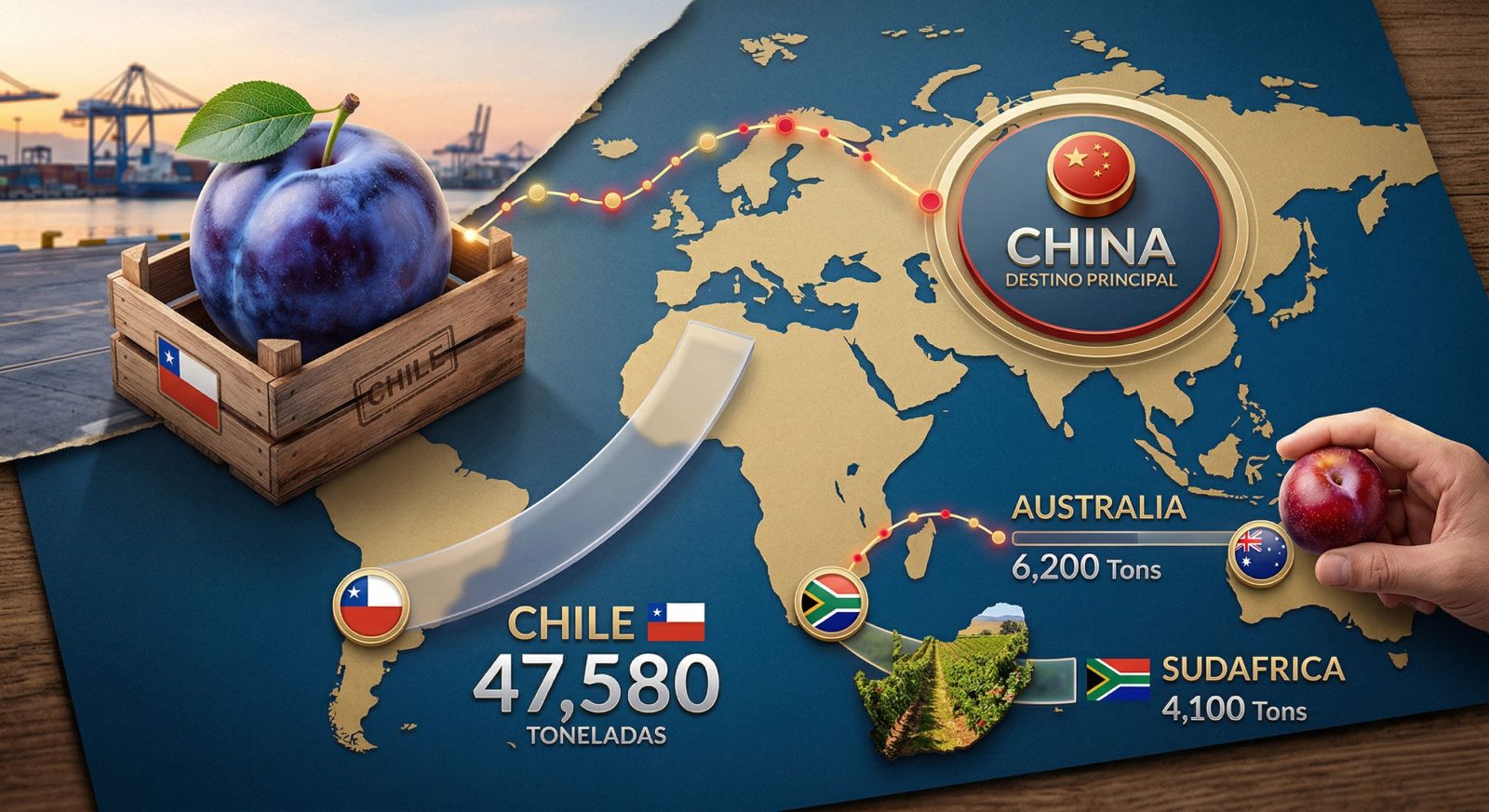
The difference in scale is telling: while Australia sends 850 tons by air and South Africa barely 20 tons (an emerging source with a health protocol approved in October 2025), Chile overwhelmingly dominates with a total of 47,580 tons, combining air shipments and the large volume by sea.
Chile: The Undisputed Supplier of the Southern Hemisphere
With 45,280 tons shipped by sea further 2,300 tons by air, Chile accounts for virtually all of China's supply of fresh D'Agen plums from the Southern Hemisphere during the season. This dominant position is not accidental: it is the result of years of work in opening markets, obtaining phytosanitary certifications, investing in cold chain logistics, and building commercial relationships with Chinese importers and processors.
Chilean air shipments (2,300 tons) represent the premium segment of the market: product that arrives in optimal freshness conditions to the highest value channels, such as large supermarket chains and luxury markets in Shanghai, Beijing and Guangzhou.
Australia: The Seasonal Competitor
Australia entered the Chinese market in January, with 850 tons shipped exclusively by air. Although its volume is marginal compared to Chile, Australian products have a presence in the premium segment and in specific niches of the Chinese market, especially in high-income cities. The relative geographical proximity and strong trade ties between Australia and China facilitated this entry, although restrictions affecting bilateral trade in recent years have limited its growth.
South Africa: The New Arrival
With just 20 tons in its first season of access (the phytosanitary protocol was approved in October 2025), South Africa is the most recent entrant to the Chinese market for fresh D'Agen plums. Its shipments are by air, and its impact on the market is still negligible. However, the opening of the protocol signals that China is diversifying its supply sources, which in the medium term could mean additional competition for Chile if South Africa manages to scale up its exports.
The Market-Setting Price: 16 RMB/kg in T2026
According to data from Ranco Americas, the The wholesale price for J-grade for the T2026 season is set at 16 RMB per kilogram. This data is key to understanding the profitability equation for exporters: with maritime logistics costs around USD 0.30-0.50/kg and considerably higher air freight, the available margin defines the viability of each shipping method. The price of 16 RMB/kg (approximately USD 2.2/kg) indicates a competitive market where operational efficiency is as important as product quality.
The Challenge of Maintaining Leadership
The landscape of the Southern Hemisphere in the Chinese market shows that Chile has a structural advantage that will be difficult to replicate in the short term. However, the entry of new origins and the potential rise of Australia demand a proactive strategy: continued investment in quality, traceability, commercial presence in China, and product differentiation are the pillars for defending and expanding the dominant position that Chile currently holds in the world's largest market for fresh D'Agen plums.







 Spanish
  English
  Chinese


Leave a comment