






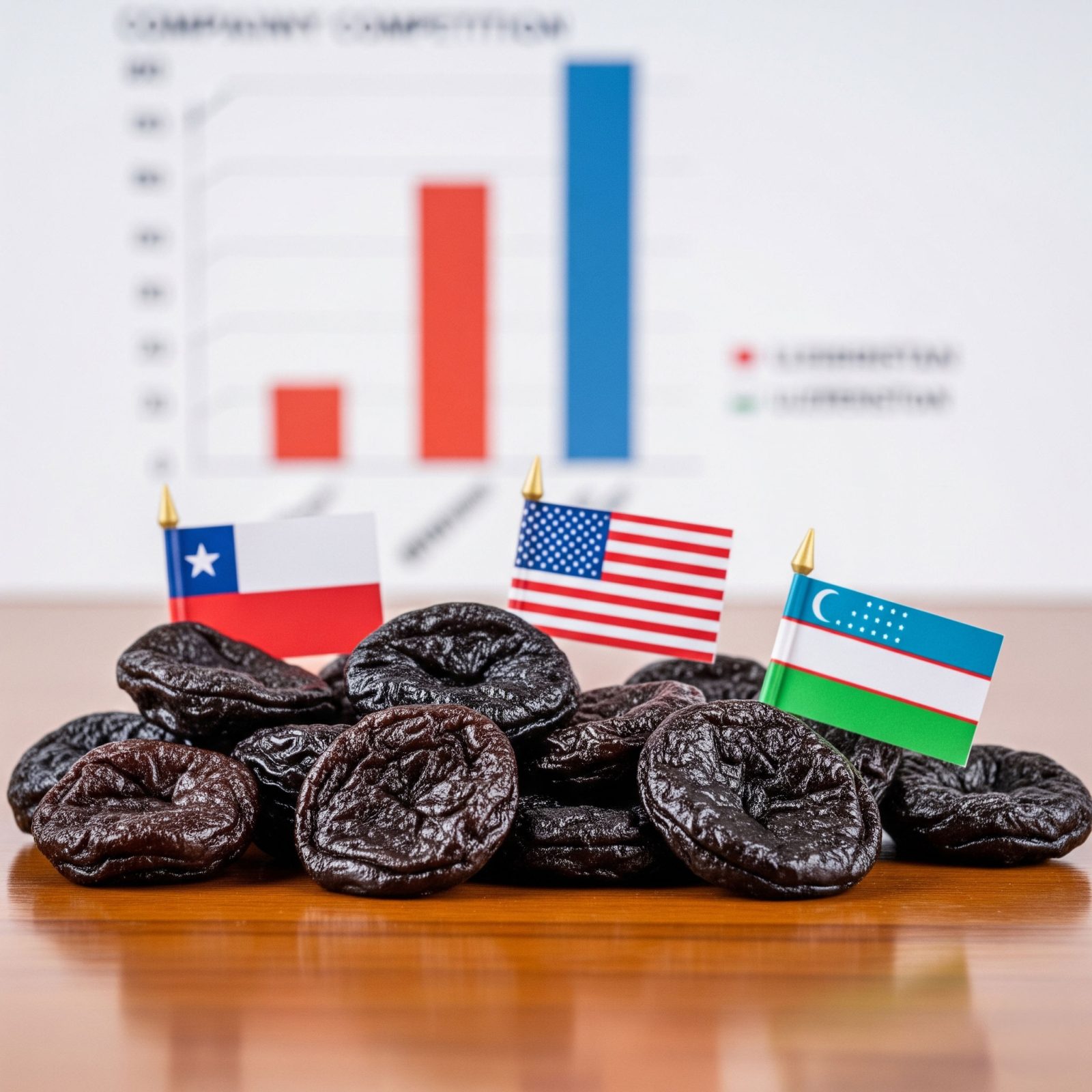
Chile, the USA and Uzbekistan: The Battle for the Main Importing Markets
Analysis of global imports of dried plums by country of origin reveals active competition among the top three exporters —Chile, the United States, and Uzbekistan— in the world's most important markets. Each has different strengths, and the battle for market share is fought with different weapons: price, quality, geographical proximity, and established business relationships.
China: The Great Battlefield
In the Chinese market, the largest in the world, Chile dominates decisively as the main supplier of dried plums. Chilean plums enjoy strong brand recognition among Chinese consumers and processors, backed by years of collaboration between the private sector and ProChile. However, Uzbekistan has steadily gained ground, especially in the low-to-mid price segment, competing directly in mass distribution channels. USA It also maintains a presence in the Chinese market, although with smaller volumes and geared towards premium segments.
Mexico: Chilean Predominance
In Mexico, the world's second-largest importer, Chile leads by a wide margin. The trade relationship between Chile and Mexico, facilitated by free trade agreements and shared Latin American culture, has allowed Chile to build a dominant position. The United States, due to its geographic proximity, also has a significant presence in this market, while Uzbekistan has not yet achieved significant penetration.
Poland and Germany: Eastern and Central Europe
In European markets such as Poland and Germany, competition is more balanced. Chile and the U.S. share the spotlight In these markets, buyers value both consistency in size and color as well as food safety standards. Uzbekistan has a limited presence in Europe, although its expansion into this continent is a plausible scenario in the medium term.
Russia: The Market Where Uzbekistan Gains Strength
In Russia, However, the scenario is different: Uzbekistan's geographical proximity and historical ties to the Russian market give it a significant competitive advantage. In this context, Chile faces greater logistical and tariff challenges, which has led to a more limited presence compared to China or Latin American markets.
Japan and Turkey: Markets of Opportunity
In Japan, In a high value-added market, Chile competes primarily with the US, focusing on the premium segment. Turkey, For this importer that also acts as a re-exporter, the dynamics are different: this country buys from multiple sources to supply its regional processing and distribution chain. Chile's ability to offer consistent and certified products is its main competitive advantage in these markets.
The Right Strategy: Differentiation and Diversification
The comparative analysis of competition between origins offers a clear lesson for the Chilean industry: producing in volume is not enough. differentiation through quality, traceability and sustainability This is the way to maintain and expand market share in premium markets, while logistical efficiency and trade agreements are key to competing in more price-sensitive markets.







 Spanish
  English
  Chinese


Leave a comment