






Global Prune Production: A Market Concentrated in the Hands of a Few Players
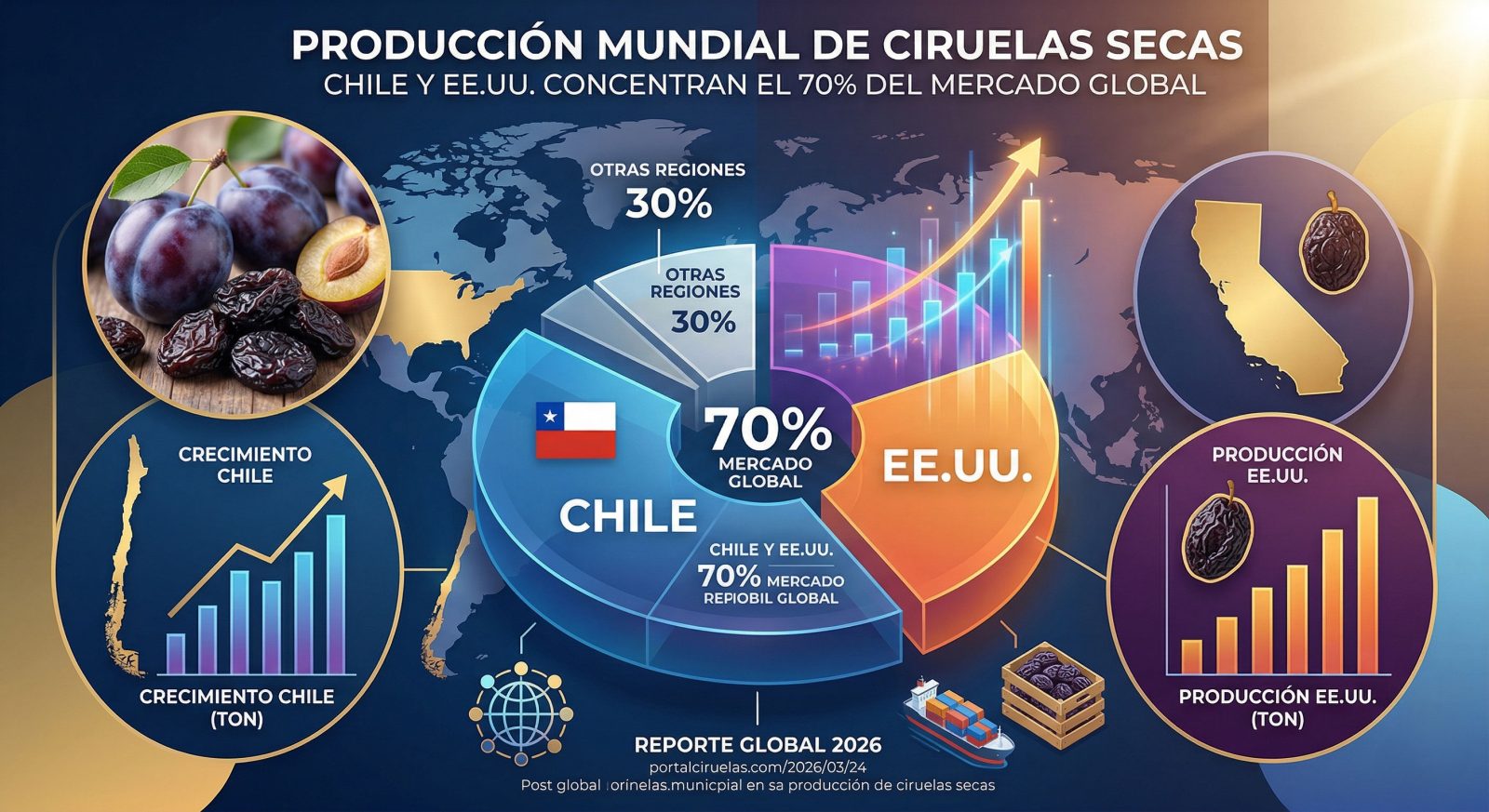
The global market for dried plums is dominated by a small group of countries that account for virtually all global production. According to data presented at the 13th Dried Plum Expo, The four main producing countries —Chile, the United States, France and Argentina— represent the 95% of the total world volume, This makes this industry one of the most geographically concentrated within the dried fruit sector.
Chile and the U.S.: The Production Duopoly
Of that productive universe, Chile and the United States alone account for approximately 70% of the global volume. This binational concentration has direct implications for international price formation, supply availability for major importing markets, and the negotiating power of both countries with buyers such as China, Mexico, and Europe.
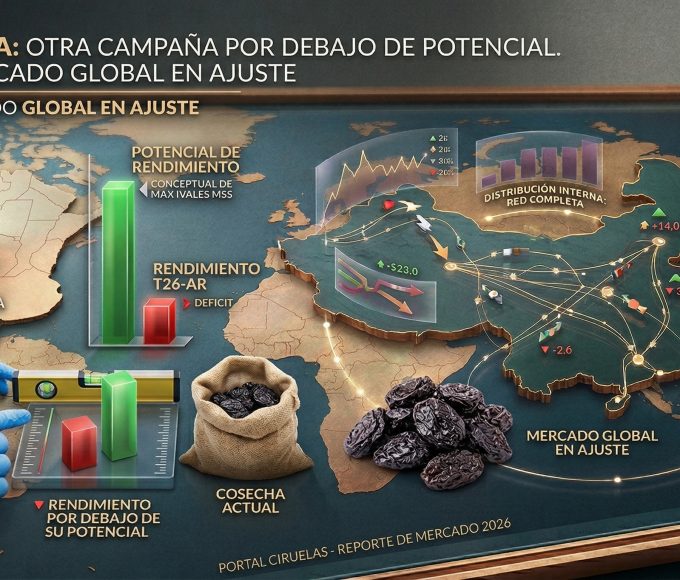
The evolution of global production, measured from the 2011/12 season to projections for 2025/26, shows an industry that remains relatively stable in terms of global volume, with year-on-year fluctuations attributable to weather conditions, variations in orchard yields, and investment decisions in new plantings. Total global production has remained in the range of 200,000 to 300,000 metric tons in recent years.
France and Argentina: Complementary Actors
France, historically linked to the variety d'Agen, And Argentina, with growing but still secondary production, completes the quartet of major producers. Both countries contribute significant volumes to the market, especially during periods when Chile or the US have smaller harvests, acting as a global supply reserve that stabilizes international supply.
Projections for the 2025/26 Season
Projections for the 2025/26 season suggest a continuation of the current production structure, with no disruptive changes in the leadership of the main countries. However, the emergence of new, smaller competitors and the sustained growth of Uzbekistan as an exporter—though not as a producer of traditional dried plums—add a layer of complexity to the analysis of the global market.
Implications for Chilean Industry
For Chile, maintaining its position within the dominant producing bloc requires constant attention on three fronts: the renewal and varietal improvement of orchards, investment in processing technology to guarantee quality and consistency, and the development of marketing strategies in high-growth markets such as China and India. The limited and concentrated global supply is, ultimately, a structural advantage for countries already positioned at the top of global production.





 Spanish
  English
  Chinese


Leave a comment