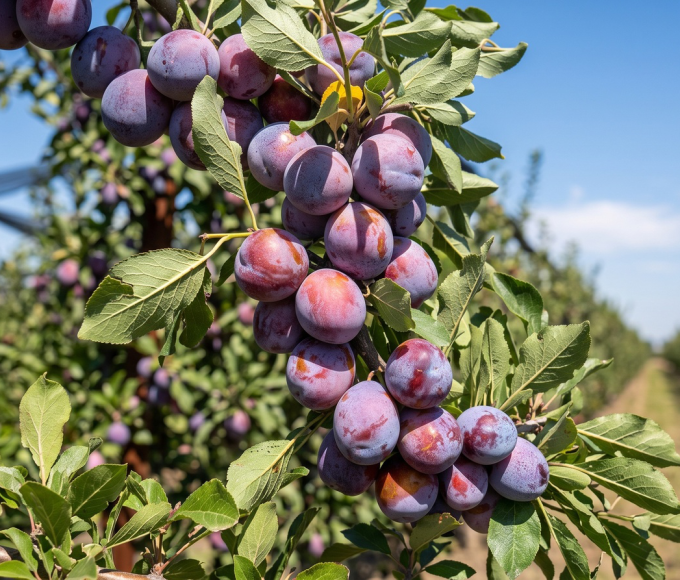
Fruit load management is one of the most critical practices in plum production. Timely and appropriate thinning improves fruit size, raises quality, increases market price, and ultimately maximizes the grower's return.
However, with operating costs constantly rising, many growers in the Sacramento Valley and across California are asking themselves the same question this season: Is thinning still economically justified?
The Problem: Cloud-Based Operating Costs
This year, rising diesel prices have significantly increased the cost of mechanized operations. Global factors have affected oil flows, while in California, these pressures have been amplified by the closure of local refineries.
To put it in perspective, The price of diesel in California increased by approximately 51% in just one month earlier this season. As a result, the rates charged by farm service providers have risen sharply.
Given this scenario, the temptation to omit thinning in order to save money in the short term is completely understandable.
The Solution: Look at the Numbers, Not Just the Costs
Avoiding thinning without assessing its real economic impact can lead to unforeseen losses that far exceed the initial "savings".
Omitting this task can cause fruit overload, which translates to:
- Smaller size and quality fruit.
- Higher drying costs (higher moisture and lower yield) dry-away).
- Increased risk of alternate bearing, which will result in fewer flowers and a drastically smaller harvest next year.
Even under high-cost conditions, thinning can still be highly profitable. The key is to compare the total benefits against the total costs, instead of focusing solely on the increase in tractor driver rates.
The Method: Partial Budget
Partial budgeting is a simple and effective tool for assessing whether a management decision will improve your profitability. You only need to answer four key questions:
- What will the new hires?
- That costs will be reduced Or will they eliminate it?
- What will the new costs?
- That revenue will be lost?
The formula is simple:
Net Change in Profit = (New Revenue + Reduced Costs) – (New Costs + Lost Revenue)
Example scenario in a Practical Case (100 Acres)
Imagine you manage a 100-acre orchard. Your carrier's rate has increased to $150/acre ($15,000 total).
- Without thinning: You expect 4.0 dry tons per acre. Due to the small size, the price drops to 1,800/ton.
- With thinning: You expect 3.5 dry tons per acre (losing 0.5 tons). But due to the large size and quality, the price rises to $2,100/ton. Furthermore, you save $30/acre in transportation and $30/acre in drying.
The result of the calculation:
Despite paying $15,000 for the service and losing half a ton per acre, the premium price ($300 extra per ton) and the post-harvest savings generate a Positive net profit of $6,000 for the orchard ($60/acre).
Conclusion: Make Profitable Decisions
Decisions about thinning should not be based solely on the rising cost of mechanical services. Although skipping thinning saves money upfront, the loss of fruit size and future problems in the orchard are often much more expensive.
Next steps for your garden:
- Evaluate your actual fruit load: Make an accurate count before making any decisions.
- Run your own numbers: Use a partial budget table with realistic estimates for your own garden.
- Protect the value of your harvest: Invest today to secure a premium product that the market demands.
To stay up to date with the best agronomic strategies in the global industry, keep exploring the Plum Portal.
Source base: Adapted and inspired by agronomic reports from the University of California (UCCE) – Sacramento Valley Orchards.
Published on April 28, 2026 by Sacramento Valley Orchards
Dominio A. Agyeman, Agricultural Economic Advisor at UCCE; Butte, Glenn and Tehama Counties Becky Wheeler-Dykes, UCCE Orchard Systems Advisor; Glenn, Tehama and Colusa Counties









 Spanish
  English
  Chinese


Leave a comment