






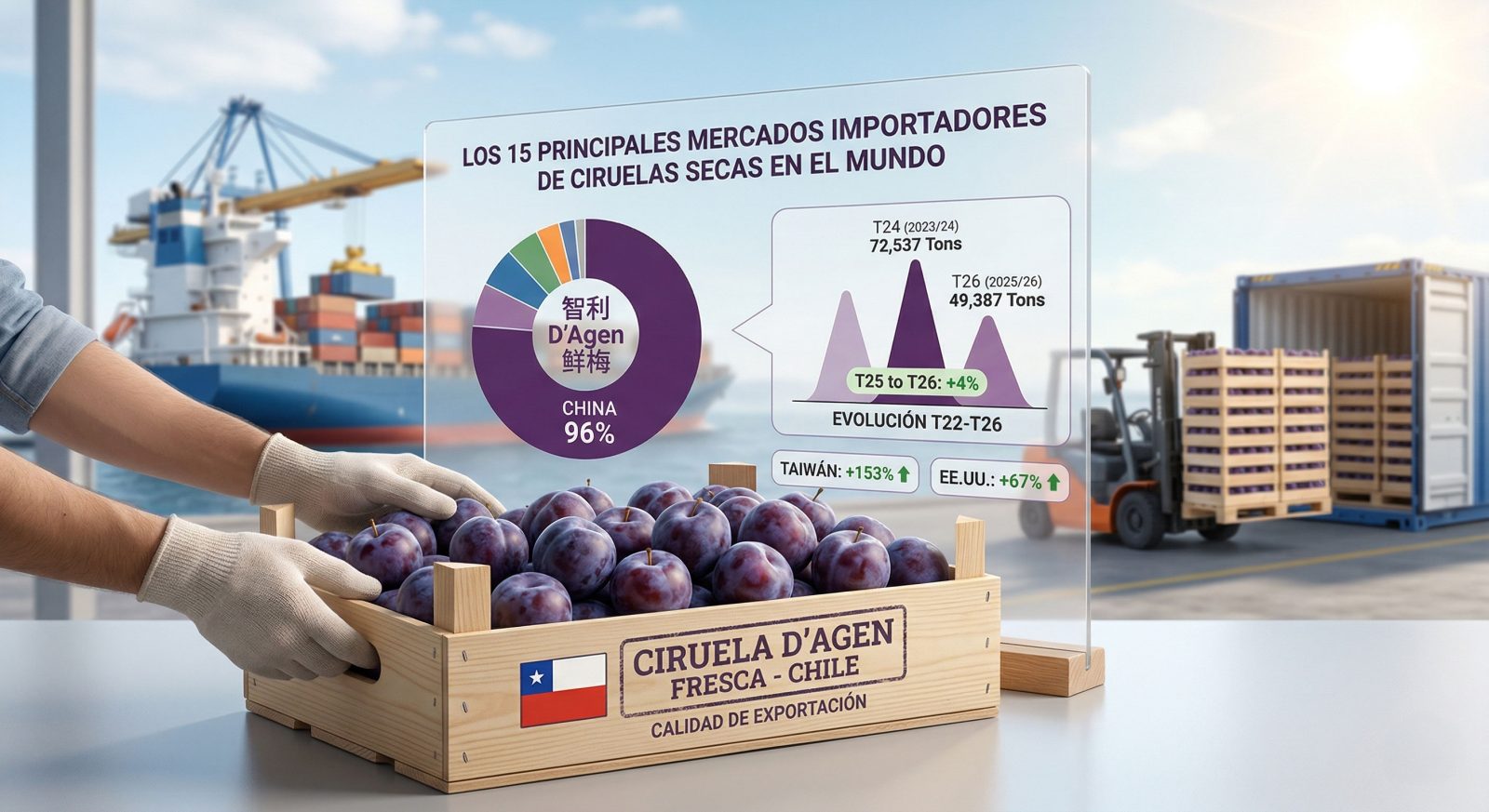
The Global Demand Map: The 15 Countries that Drive the Dried Plum Market
Understanding who buys prunes in the world is just as important as knowing who produces them. Analyzing the Top 15 importing countries It reveals a highly concentrated demand map, with China overwhelmingly leading the way and a set of developed markets forming the solid foundation of international trade in this fruit.
China: The Undisputed Giant of Imports
China China holds first place by a wide margin over all other importing countries. With volumes exceeding 40,000 metric tons annually and a clearly upward trend, the Chinese market alone accounts for a majority share of global dried plum imports. Its growth in recent years has been the most decisive factor in the dynamics of the global market.
The Large Consolidated Markets
After China, the ranking of importers includes a group of markets with stable and significant consumption:
- Mexico: Second largest importer in the world, with demand driven by domestic consumption and re-export to Central America.
- USADespite being a producer, it also imports dried plums to complement its domestic supply and meet peak demand.
- Poland y GermanyThe main European markets, with a deeply rooted consumer culture and an active processing industry.
- Russian FederationA high-volume market that has shown fluctuations due to geopolitical and economic factors.
- TurkeyIt imports for processing and re-export, taking advantage of its geographical position between Europe and Asia.
- Italy y United Kingdom: Premium European markets with consumers who value quality and certified origin.
- Japan: High-value Asian market, where dried plums are consumed as a healthy snack and in gastronomy.
Markets with Growth Potential
Among the top 15 importers, the following also stand out: Spain, Peru, Australia, Chili (which it imports to supply its own domestic market) and Netherlands —the latter acting mainly as a redistribution hub to other European markets—. These countries represent opportunities for sustained growth for Chilean exporters, especially in the high-quality product segment with sustainability certifications.
Strategic Implications for Exporters
The concentration of demand in 15 countries presents both opportunities and risks. On the one hand, it allows exporters to focus their sales and marketing efforts on well-defined markets. On the other, it creates a structural dependence on the economic cycles and import policies of a few countries. Diversifying into emerging markets such as India, Southeast Asia, and North Africa is a strategic priority increasingly recognized by the industry.






 Spanish
  English
  Chinese


Leave a comment