




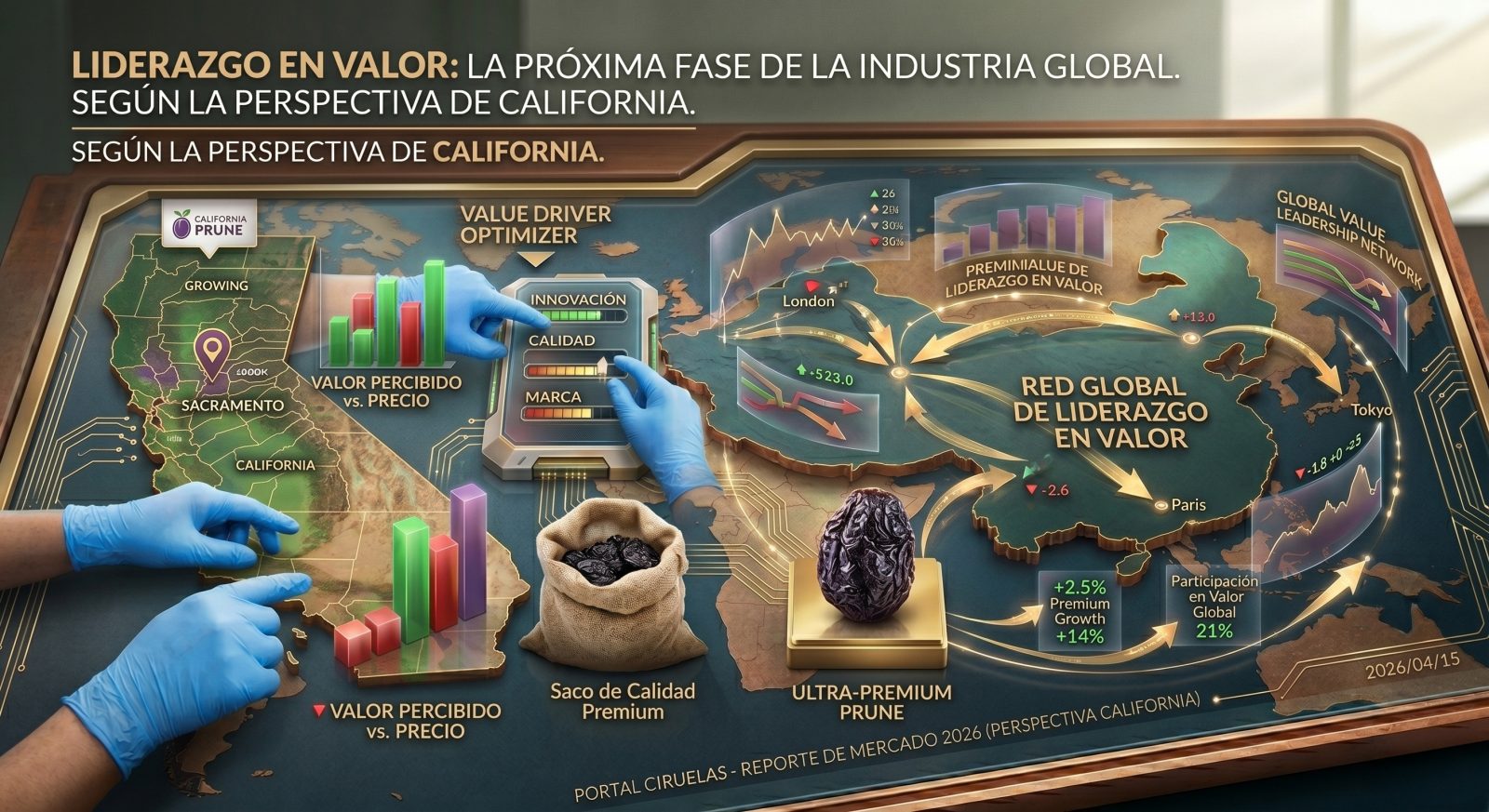
The dried plum industry has entered a new phase of global reconfiguration that demands a paradigm shift: moving from competition based on volume to a value-driven strategy. This was the central thesis presented by Joe Turkovich, a producer and member of the California Prune Board, during his presentation at the 2026 Prune Expo. After decades in which Chile displaced California as the low-cost producer thanks to its competitive advantages, the current scenario presents new challenges that require both regions to collaborate to expand the global market.
The end of cost leadership
For the past 25 years, Chile made a rational business decision by leveraging its position as an efficient producer to gain market share. However, Turkovich warned that this advantage will not last forever. The entry of new players with large plantations, such as Uzbekistan and China, which already report more trees on the ground than Chile, threatens to wrest away its title as a "low-cost supplier.".
The imminent risk of continuing to compete solely on volume is the commoditization of the product. According to the expert, selling plums based only on price is equivalent to selling potatoes, which erodes producer margins and creates a race to the bottom. The solution lies in simultaneously activating two engines: production (supply) and demand (marketing and investment).
Science as a "license to play"«
For California, the path to sustainability has been collective investment in nutritional research, a model that Turkovich suggests is vital for Chile's future. With over 70 published scientific studies, the industry has built a credibility that allows it to position the plum not just as a food, but as a true "wellness capsule.".
Advances in bone health are the strongest pillar of this strategy. Clinical trials have shown that consuming 5 to 6 plums daily helps maintain bone mineral density and reduces markers of bone loss in postmenopausal women. Furthermore, emerging research areas, such as the gut-bone axis and the impact of the microbiome on metabolic diseases, present a historic opportunity to connect with younger consumers, such as Generation Z, who prioritize functional nutrition and holistic well-being.
From volume to value: The Chilean challenge
Chile is already the world's largest producer and exporter by tonnage, but data shows that the value per metric ton of Californian fruit remains significantly higher due to its premium positioning. Leadership in volume is just one phase; the next level is leadership in value.
This implies:
- Strategic investment in marketing to generate a "pull" from the end consumer.
- Consistency and absolute quality in the product, especially for demanding markets like China.
- Differentiation through sustainability, where Chile is already making progress with its 2027 standard under the "Chile Conscious Origin" seal.
The experts' conclusion is clear: supply is easy to create, but demand is the real challenge. If the Chilean industry manages to transform its fruit from an agricultural commodity into an indispensable natural supplement, it will secure competitive returns and an unassailable position on the global shelf.




 Spanish
  English
  Chinese


