




FRANCE · MARKETS
The crisis in Agen: Due to large losses in the plum sector, they are promoting a productive reconversion towards mixed systems.
From the "blower effect" to the mortality of forests: the collapse of the Pruneau d'Agen.
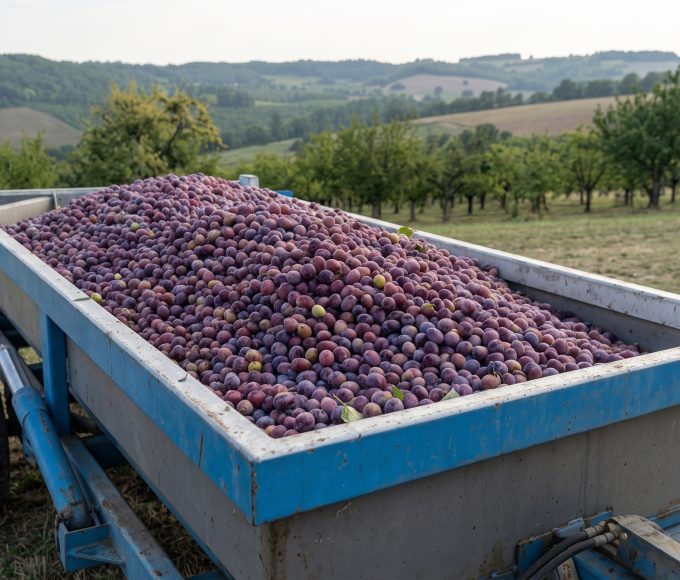
Southwest France is facing one of the most critical moments in its recent agricultural history. Between June 17 and 27, 2026, Lot-et-Garonne experienced 11 consecutive days with indoor temperatures exceeding 35°C, nighttime lows above 20°C, and extremely low humidity levels. This combination led to massive fruit drop due to direct sunburn just weeks before the start of the harvest. As we already discussed in our coverage of the historic heatwave in Francehttps://portalciruelas.com/2026/07/15/ola-de-calor-historica-en-francia-el-efecto-soplete-amenaza-desde-el-30-hasta-50-de-la-cosecha-de-agen-y-sacude-el-suministro-europeo/), the damage went beyond the performance of the current campaign.
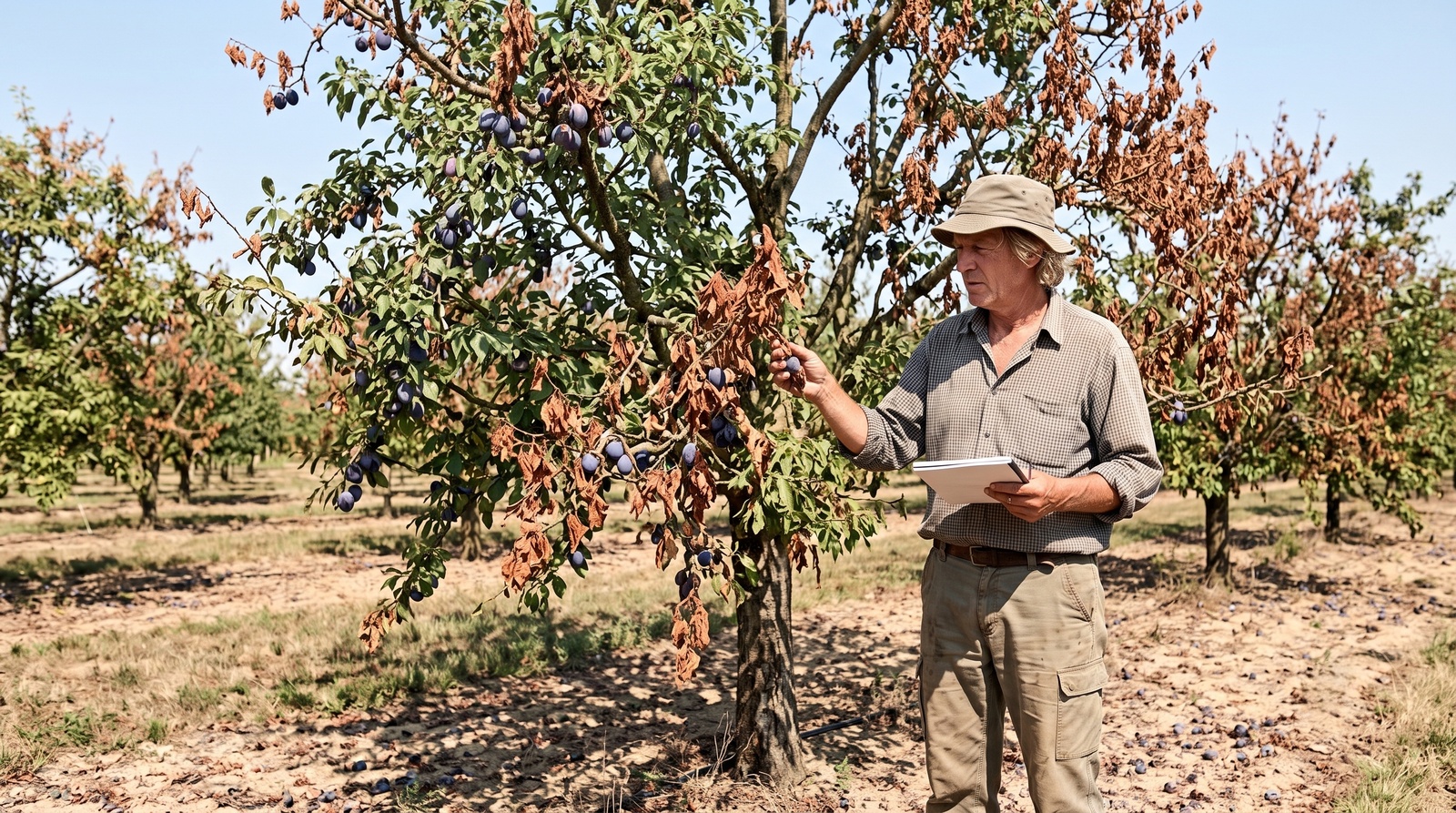
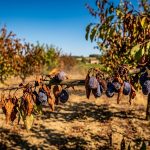
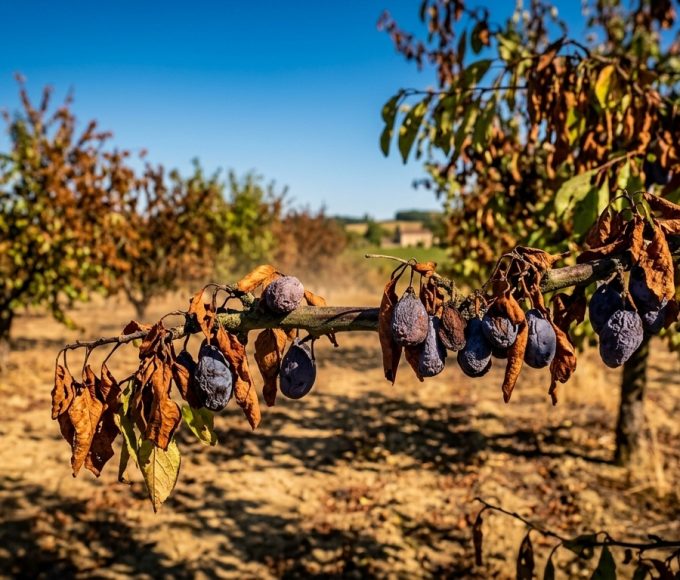
For the first time, severe defoliation, scorched structural branches, and the direct death of young and mature trees were observed. Official estimates from the National Interprofessional Pruneau Office confirm production losses ranging from 101 to 1001 tons, depending on the location and management system of the orchard.
Adding to the climate catastrophe is a genetic and regulatory bottleneck. Producers warn that the last major approval of a rootstock for the Ente plum dates back to 1985. Plant material mass-produced from industrial micro-cuttings lacks the root vigor necessary to tolerate sustained periods of water stress. Furthermore, the rules of the Protected Geographical Indication (PGI) prevent farmers from selecting or propagating their own local rootstocks, blocking any attempt at rapid agronomic adaptation on the farm.
The heart of the southwest: strategic diversification with shared machinery
Faced with the vulnerability of the plum tree, some producers in the region will accelerate a diversification project, anticipating the degradation of the historical monocultural model.
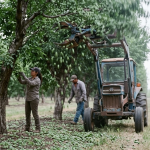
The agronomic advantage of the almond tree lies in its greater heat tolerance and the natural protection the shell provides the fruit from direct sunlight. However, the greatest appeal for local farms is financial and operational: the heavy machinery used for harvesting, shaking, and collecting the plums is exactly the same as that used in almond cultivation.
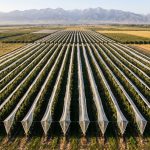
The contrast in the Lot-et-Garonne landscape is striking. On one side of the road, you see devastated plum orchards with orange leaves and dried fruit on the ground; on the other, rows of almond trees in full bloom. For some, the solution isn't to replace the plum—an emblematic crop of southwest France—but to complement it with almond trees to diversify production, strengthen the economic stability of farms, and reduce vulnerability to increasingly extreme weather events.
Local nursery owners warn that it will take at least two years to produce enough plum saplings to replace the burned trees. If you're looking to replant in the short term, you'll find the supply severely stalled, extending France's production gap until the end of the decade.
From anguish in the countryside to direct demands on Macron's government
The crisis in the fields has triggered strong institutional and union demands. In the commune of Montesquieu, long-established fruit growers are reporting losses of between 301 and 401% of their harvest due to the extreme heat, exacerbated by isolated hailstorms. Current restrictions on the Garonne River limit irrigation to only two days per week, resulting in a 301% reduction in the water supply needed to sustain the trees.
Faced with this scenario, the FDSEA 47 and Young Farmers (JA 47) unions are demanding immediate financial relief measures to prevent mass bankruptcies:
- A "tax-free year" and the suspension of contributions to the Agricultural Social Security (MSA).
- General exemption from property tax on undeveloped agricultural land.
- Implementation of partial unemployment schemes for workers in the sector affected by the heat wave.
- Acceleration of projects for rainwater storage during the winter.
Political pressure escalated to the national level. Marcel Calmette, mayor of Paulhiac, sent an open letter to President Emmanuel Macron and Agriculture Minister Annie Genevard, calling the situation a "life-or-death emergency" for the country's food sovereignty.
- **Reconfiguration of European supply:** The loss of volume in France will keep European stocks at historic lows, opening up sustained opportunities for origins such as Chile, Argentina and the US to supply the pitted plum market.
- **Genetic material reviews:** The crisis in Agen demonstrates the operational risk of working with old rootstocks. It is time to evaluate the thermal and root resistance of varieties under development in all producing regions.
- **Optimization of fixed assets:** The experience of co-investment in almond orchards demonstrates that agricultural income can be diversified without duplicating the cost of harvesting and drying machinery.
Despite calls for restructuring, the French sector knows that the pace of biological and agronomic research doesn't align with the financial urgency of producers. Rebuilding the fruit-growing region of Lot-et-Garonne will take years, redefining the balance of the international prune trade.




 Spanish
 English
 Chinese


Leave a comment