




[FRANCE · MARKETS]
Three blows for the Agen plum: extreme heat, lack of water and skyrocketing gas prices.
Between 30% and 50% of total production, there is a risk of loss.
The impact continues to manifest itself unevenly across different growing areas,» emphasizes the National Interprofessional Plum Office (BIP). However, preliminary calculations already show the severity of the damage: between 301 and 501 tons of total production is at risk of being lost. It is very likely that this statistic will change before the end of the period if further heat waves continue to affect the orchards.
Triple blow at the start of the harvest: heat wave, critically low water levels, and record-breaking gas prices
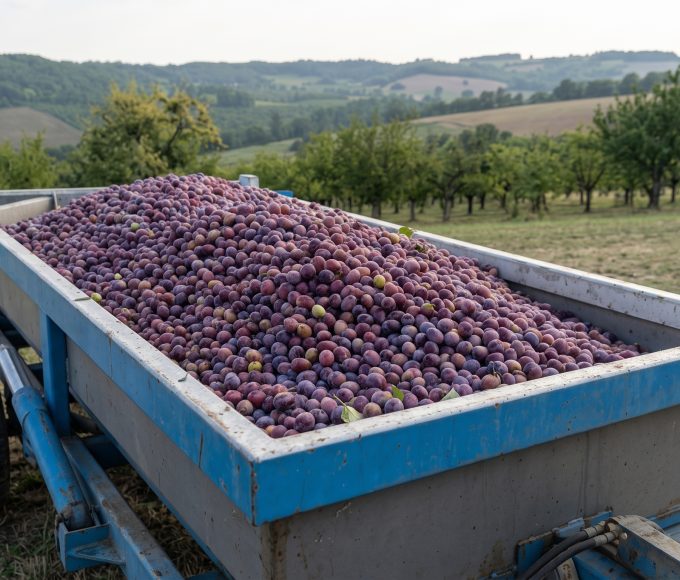
The arrival of the snow shakers in the mountains of southwestern France in mid-August formally marks the start of one of the most challenging harvesting seasons in recent memory in the Lot-et-Garonne basin. Far from bringing relief, the activation of the mechanical shakers coincides with a fifth confirmed heatwave for the second week of August, with temperatures expected to reach nearly 41°C in key areas such as Villeneuve-sur-Lot and Cazideroque.
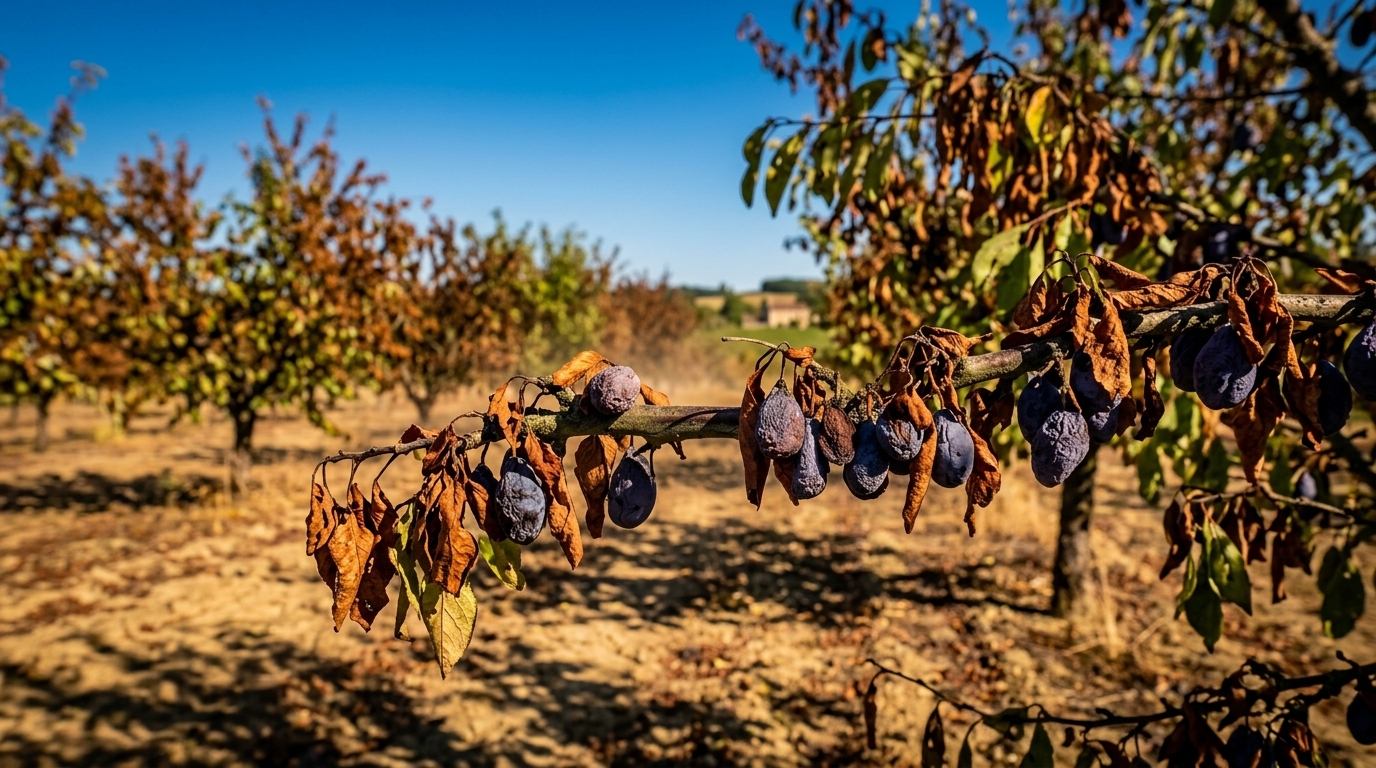
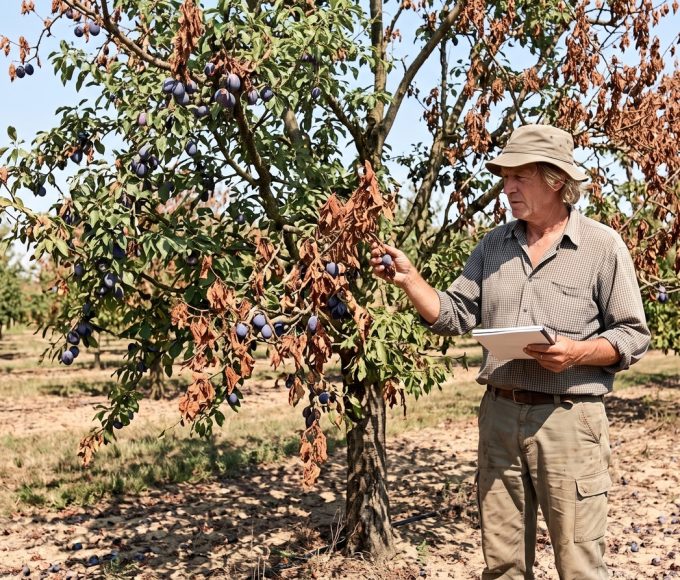
As we analyzed in [our coverage of the heat wave in France](https://portalciruelas.com/2026/07/15/ola-de-calor-historica-en-francia-el-efecto-soplete-amenaza-desde-el-30-hasta-50-de-la-cosecha-de-agen-y-sacude-el-suministro-europeo/The so-called "hair dryer effect" had already caused massive fruit drop and irreversible foliage burns during June and July. However, the current situation adds a new, major operational and financial complication for processing plants: the cost of the fuel essential for drying the fruit.
The geopolitical conflict in the Middle East significantly boosted natural gas prices. According to the Interprofessional Prune Bureau (BIP), the INSEE indicator for gas destined for agricultural use reached its highest level since December 2013. Drying Ente plums to transform them into the traditional Pruneau d'Agen It requires intensive use of continuous ovens. Today, processors must assume exorbitant energy costs to process a heterogeneous and markedly scarce raw material.
| Plum harvest volumes in France (Tons) | Worth | |
|---|---|---|
| 2023 | 40,500 T | |
| 2024 | 30,500 T | |
| 2025 | 27,000 T | |
| 2026 (BIP Projection) | Less than 27,000 T |
Accumulated damage to wood: the debate over water and the survival of the forest
Immediate fruit losses don't tell the whole story. In large plots across the Lot Valley, plum trees show scorched upper branches and complete photosynthetic cessation. Water stress has affected flower induction for the upcoming cycles, directly compromising the production potential for 2027 and 2028. In fact, experts estimate that overall losses range from 301 to 501 to 301 tons, reaching up to 801 to 1001 to 300 tons in rainfed farms. In extreme cases, entire plots are being uprooted to convert to alternative crops such as citrus and almonds, among others, although producers understand that this conversion requires years of financing and technical training.
The availability of water for irrigation has become the central issue in the political and agricultural debate in the region. While the Emergency Agricultural Law aims to double the water storage capacity for agricultural use by 2035, current basins and reservoirs are depleted. Farmers with irrigation systems have managed to save up to half of their yields, while farms without access to water have suffered total losses.
The urgent need for storage infrastructure clashes with environmental restrictions, but the reality on the ground is relentless: without sustained water supplies during peak periods with evapotranspiration of 10 mm per day, the survival of fruit trees in southern Europe becomes unfeasible.
The French processing sector faces a perfect storm: lower availability of raw materials, fruit of compressed size due to lack of sugars and gas drying costs at a 13-year high.
European market undersupplied and reconfiguration of global flows
France produces approximately 761,000 tons of Protected Geographical Indication prunes annually, playing a key role as a packing and distribution hub for all of Europe. After two previous seasons marked by frost and hail, carryover stocks (carry-over) between industries are at historic lows.
The confirmation of a 2026 harvest significantly lower than last year's 27,000 tons—a volume that was already mediocre—will leave the 60 French processing companies facing severe supply constraints. To meet supply schedules for supermarkets and industrial channels across Europe, European buyers will have to turn to the international market to find replacement volumes.
This situation is reshaping global trade dynamics. The shortage of large fruit in Europe will put upward pressure on prices for premium sizes and accelerate import contract negotiations in the second half of the year. International traders monitoring supply should closely follow price developments in the European spot market over the coming weeks.
- **Monitoring of sizes and sugars:** Fruit entering ovens may have a lower carbohydrate content and smaller sizes, increasing the relative value of larger fruit.
- **Active import demand:** European packers will seek to fill volume gaps through contracts with sources in the Southern Hemisphere and North America.
- **Pressure on transfer prices:** The cost of gas and the shortage of supply will force upward adjustments in the final prices of pitted plums.
- **Water investment:** The crisis in southwest France reinforces the global need to prioritize reservoirs and shading nets against radiative stress.
The start of the 2026 harvest in Lot-et-Garonne demonstrates that extreme weather events and energy crises are no longer isolated incidents. The dried plum industry is undergoing a restructuring where security of supply and water efficiency will define the strongest competitors in the international market.






 Spanish
  English
  Chinese


Leave a comment